
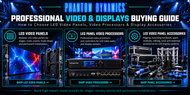
LED Video Wall Buying Guide: Panels, Processors & Accessories | Phantom Dynamics
September 26, 2026, 4:43 pm
Professional LED Video Wall & Display Buying Guide
Learn how to choose LED video panels, video processors, display controllers and accessories for concerts, stages, nightclubs, trade shows, corporate events and permanent video-wall installations.
What Does Your LED Video System Need?
A professional LED display system starts with the panels, then adds processing, control, power, mounting and service components. Each section below links directly to the corresponding Phantom Dynamics category.
LED Video Panels
Modular LED display panels for video walls, concert stages, event backdrops, clubs, trade shows and permanent installations.
Shop LED Video Panels → Processing + ControlLED Panel Video Processors
Processors and controllers for scaling, routing, synchronizing and managing content across compatible LED displays.
Shop Video Processors → Setup + ServiceLED Video Panel Accessories
Mounting, calibration, data, power, service and support equipment for compatible LED video-panel systems.
Shop Video Accessories →How to Choose a Professional LED Video Display System
Professional LED video walls are built from modular display panels that work together as a larger screen. They are used for concert visuals, stage backdrops, nightclub displays, trade-show exhibits, corporate events, digital signage and permanent entertainment installations.
Phantom Dynamics currently organizes Video & Displays into three major areas: LED Video Panels, LED Panel Video Processors and LED Video Panel Accessories. :chatgpt-content-reference{index="1"}
LED Video Panels
LED video panels are modular display cabinets that can be connected to form larger video walls and custom display shapes.
The current Phantom Dynamics catalog includes panels with different pixel pitches, high-resolution models, curvable designs and outdoor-rated options. Current examples include ADJ EVS3 FLEX45, VS1-series panels, WMS2 panels and Blizzard Lighting outdoor-rated displays. :chatgpt-content-reference{index="2"}
Understanding Pixel Pitch
Pixel pitch describes the distance between individual LED pixels on a display panel. Smaller pixel pitches generally place the pixels closer together, which can improve perceived detail at shorter viewing distances.
Larger-pitch panels can still be very effective when the audience is farther away. The correct choice depends on viewing distance, display size, application and budget.
Indoor vs. Outdoor LED Panels
LED panels intended for indoor and outdoor environments can have different brightness, enclosure and environmental specifications.
If a display will be exposed to weather or used outdoors, choose equipment specifically rated by the manufacturer for that environment rather than assuming an indoor panel can be used outside.
LED Panel Video Processors
LED panel video processors manage the incoming video signal and prepare it for the LED display system.
Depending on the processor, functions can include scaling, source switching, display mapping, image adjustment, synchronization and multi-screen management.
The current Phantom Dynamics catalog includes NovaStar processors and controllers such as the TU-series, MX-series and VX-series platforms. :chatgpt-content-reference{index="3"}
Controllers, Sending Systems & Signal Distribution
Larger LED video walls may require dedicated control and signal-distribution hardware in addition to the main processor. System design can involve sending cards, receiving systems, network connections, fiber converters and other data hardware.
For more complex systems, plan the processor, signal path and panel configuration together so the equipment is compatible from source to screen.
LED Video Panel Accessories
LED video panel accessories cover the supporting equipment required to install, maintain, connect and service an LED display system.
Current Phantom Dynamics products include panel rigging tools, module-removal tools, ambient brightness sensors, fiber converters, monitoring hardware, calibration products and other video-display system accessories. :chatgpt-content-reference{index="4"}
Mounting & Rigging LED Video Panels
LED walls may be ground-supported, mounted to compatible structures or suspended using manufacturer-approved hardware. The exact method depends on the panel design and application.
For truss, mounting and support components, also explore Phantom Dynamics Truss & Rigging. Video-panel mounting should always follow the panel manufacturer's specifications and documented load limits.
Power, Data & Cabling
A complete display requires both electrical power and a reliable data path. Larger walls can require multiple power circuits, data runs and carefully planned signal distribution.
Consider cable type, run length, connector format, processor outputs and the number of panels being connected when planning the system.
Start With Where the Video Wall Will Be Used
Concerts & Touring
Modular panels, processors and road-ready accessories support large visual backdrops and touring productions.
Nightclubs & Venues
LED displays can become permanent visual centerpieces behind DJs, stages and entertainment areas.
Trade Shows
Modular video walls can create high-impact product displays, branded environments and booth backdrops.
Corporate Events
LED walls can display presentations, live video, branding and multimedia content in large event spaces.
Theaters & Stages
Video panels can support scenic backgrounds, multimedia productions and dynamic stage environments.
Permanent Installations
Installed systems require careful planning around viewing distance, mounting, ventilation, service access, processing and power.
Match the Video Product to the Job
| What You Need | Good Starting Category |
|---|---|
| Build the actual LED video wall | LED Video Panels |
| Scale, map and manage video content | LED Panel Video Processors |
| Mount, connect, calibrate or service the display | LED Video Panel Accessories |
| Support the display with professional structures | Truss & Rigging |
System planning note: LED panels, processors, receiving hardware, data connections, mounting systems and electrical power must all be compatible. Verify pixel pitch, resolution, processor capacity, cabinet configuration, input/output formats, power requirements and manufacturer-approved mounting methods before building a complete display.
Build Your Professional LED Video Display
Explore modular LED video panels, professional video processors and display accessories for stages, concerts, venues, trade shows and permanent visual installations.
Shop Video & Displays →LED Video Wall Questions
What is an LED video wall?
An LED video wall is a larger display created by combining multiple modular LED panels into one coordinated screen.
What does pixel pitch mean on an LED panel?
Pixel pitch is the spacing between LED pixels. Smaller pitch generally supports closer viewing distances and finer perceived detail, while larger pitches can work well when viewers are farther from the display.
What does an LED video processor do?
A video processor prepares incoming video content for the LED display and may provide scaling, switching, image adjustment, mapping and other control functions.
Can LED video panels be used outdoors?
Some panels are designed and rated for outdoor use, while others are intended only for indoor environments. Always verify the manufacturer's environmental rating for the specific panel.
Can different LED panels be mixed in one video wall?
Compatibility depends on the panel design, processor, resolution, electrical requirements and control system. A matched panel system is generally easier to configure and maintain than a mixture of unrelated products.
What accessories does an LED video wall need?
Depending on the system, accessories may include mounting or rigging hardware, power and data cables, processing hardware, calibration tools, sensors, fiber converters, spare modules and service tools.