
DMX Lighting Control Buying Guide: Controllers, Wireless & Interfaces | Phantom Dynamics
September 26, 2026, 5:28 pm
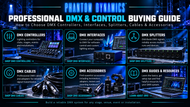
Professional DMX & Lighting Control Buying Guide
Learn how to choose DMX controllers, wireless DMX systems, splitters, lighting-control software, gateways, interfaces, dimmer packs and power-distribution equipment for stages, venues, DJs, theaters and permanent installations.
What Does Your Lighting-Control System Need?
Start with how you want to control and distribute your lighting data. Each section links directly into the corresponding Phantom Dynamics DMX & Control category.
DMX Controllers
Hardware lighting controllers for programming and operating compatible lighting and effects systems.
Shop DMX Controllers → Cable-Free DistributionWireless DMX
Wireless transmitters, receivers and bridges for compatible DMX lighting systems.
Shop Wireless DMX → Signal DistributionDMX Splitters & Distribution
Split and distribute DMX data across multiple fixture runs and equipment locations.
Shop DMX Splitters → Computer-Based ControlLighting Control Software
Software solutions for programming, sequencing and managing compatible professional lighting systems.
Explore Control Software → Switched + Dimmed LoadsDimmer & Relay Packs
Control compatible conventional loads and switched devices within lighting and production systems.
Shop Dimmer & Relay Packs → Power ManagementPower Distribution
Power-management and distribution equipment for professional lighting and production installations.
Shop Power Distribution → Setup + SupportController Accessories
Supporting accessories for compatible controllers, control systems and lighting installations.
Shop Controller Accessories → Network + Protocol IntegrationDMX Gateways & Interfaces
Interfaces and network nodes for connecting DMX, software and compatible Ethernet-based control systems.
Shop Gateways & Interfaces →How to Choose a DMX Lighting Control System
DMX control allows compatible lighting and effects equipment to communicate through a common control system. A basic setup may use a compact controller connected directly to a series of fixtures, while larger productions can use software, network gateways, wireless links and multiple distributed DMX runs.
Phantom Dynamics organizes its DMX and lighting-control equipment into dedicated categories for controllers, wireless DMX, signal distribution, software, dimmer and relay packs, power distribution, accessories and gateways/interfaces.
DMX Controllers
DMX controllers are the primary user interface in many lighting systems. They can range from compact standalone controllers to sophisticated consoles designed for larger shows and multi-universe systems.
The current Phantom Dynamics catalog includes standalone lighting controllers and more advanced console-style systems, so the best choice depends on fixture count, programming complexity and how much hands-on control is needed. :chatgpt-content-reference{index="1"}
Wireless DMX
Wireless DMX can reduce the need to run data cabling between certain fixture locations. A typical system uses a transmitter, receiver or transceiver to carry compatible DMX data wirelessly.
This can be useful for mobile DJs, temporary events, architectural locations and difficult cable runs. Wireless systems should be selected with compatibility, range and the specific operating environment in mind.
DMX Splitters & Distribution
DMX splitters and distribution equipment allow one incoming control signal to be distributed across multiple output branches.
This can simplify larger lighting systems where several groups of fixtures are positioned in different areas of a stage or venue. Current catalog examples include professional rackmount DMX/RDM data splitters. :chatgpt-content-reference{index="2"}
Lighting Control Software
Lighting control software provides computer-based programming and show-control capabilities for compatible lighting systems.
Software can be especially useful for programmed scenes, cue-based productions, time-coded events and systems where visual programming offers more flexibility than a small physical controller.
DMX Gateways & Interfaces
DMX gateways and interfaces connect lighting-control environments that may use traditional DMX, computers or network-based protocols.
The current Phantom Dynamics catalog includes products that bridge DMX with Ethernet-based control such as Art-Net and sACN, as well as computer-control interfaces. :chatgpt-content-reference{index="3"}
Dimmer & Relay Packs
Dimmer and relay packs can provide controlled switching or dimming for compatible equipment within a professional lighting system.
Selection depends on the type of load being controlled, electrical requirements and the specific operating mode supported by the pack.
Power Distribution
Power distribution equipment handles the electrical side of professional lighting systems rather than the DMX data itself.
Larger installations often need to plan both control distribution and power distribution independently so fixtures receive the required data and electrical supply.
Controller Accessories
Controller accessories can help complete a professional control setup with compatible supporting components used around consoles, interfaces and lighting-control installations.
Start With the Way the System Will Be Used
Mobile DJs
Compact controllers and wireless DMX can help keep portable lighting rigs flexible and easier to deploy.
Nightclubs
Permanent venues may combine controllers, splitters, gateways and software for more complex fixture networks.
Theaters
Cue-based software and professional consoles can support programmed scenes, transitions and larger productions.
Concerts & Stages
Larger systems may require multiple universes, network nodes and distributed DMX outputs across a stage.
Houses of Worship
User-friendly controllers or software can support repeatable lighting scenes for recurring services and productions.
Permanent Installations
Gateways, interfaces and networked control can help integrate larger venue and architectural systems.
Match the Control Product to the Job
| What You Need | Good Starting Category |
|---|---|
| A physical console or standalone lighting controller | DMX Controllers |
| Send DMX data without a traditional cable run | Wireless DMX |
| Distribute one DMX signal to multiple branches | DMX Splitters & Distribution |
| Program lighting from a computer | Lighting Control Software |
| Connect DMX to networked or software-based systems | DMX Gateways & Interfaces |
| Control compatible switched or dimmed loads | Dimmer & Relay Packs |
| Manage electrical distribution for a lighting system | Power Distribution |
| Supporting hardware and control-system components | Controller Accessories |
System planning note: DMX control, network data and electrical power are separate parts of a professional lighting system. Verify protocol, connector type, universe requirements, fixture compatibility and electrical specifications before selecting equipment.
Build Your Professional Lighting-Control System
Explore DMX controllers, wireless DMX, splitters, software, gateways, interfaces, dimmer packs, power distribution and accessories across the Phantom Dynamics control catalog.
Shop DMX & Control →DMX & Lighting-Control Questions
What is DMX lighting control?
DMX is a commonly used digital control system for compatible stage lighting and effects equipment. A controller sends data that tells addressed fixtures how to respond.
What is a DMX universe?
A standard DMX universe provides up to 512 control channels. Fixtures may use one or many channels depending on their functions and selected operating mode.
What does a DMX splitter do?
A DMX splitter takes an incoming DMX signal and creates multiple output branches, helping distribute control data to different groups of fixtures.
Can DMX be sent wirelessly?
Yes. Compatible wireless DMX transmitters, receivers and transceivers can carry lighting-control data without a traditional DMX cable between certain points in the system.
What are Art-Net and sACN?
Art-Net and sACN are network-based methods commonly used to transport lighting-control data over Ethernet networks. Compatible nodes and gateways can convert or distribute that data to DMX equipment.
Do I need lighting-control software?
Not necessarily. Smaller setups can often use a standalone hardware controller. Software becomes more useful when you need more complex programming, visual editing, networking or larger show-control capabilities.